Case Study · Service Design · Rural Behavioral Health
Rural behavioral health, redesigned from the inside out.
A patient experience framework for three rural North Carolina hospitals — built through community research, stakeholder interviews, and co-design with the clinicians, peer recovery coaches, administrators, and patients who would actually use it.
- Role
- Lead Service Designer
- Organization
- Novant Health
- Period
- 2017 — 2019
- Scope
- Three rural North Carolina hospitals · Emergency department behavioral health support · Peer recovery coach integration · Grant strategy and implementation planning
- Research Focus
- What does it take to build behavioral health support inside rural hospitals already carrying more than they were designed to hold?
Opening Question
Rural emergency departments had become the behavioral health front door. They were not built for that.
The question was not abstract.
- —Patients were arriving in crisis.
- —Staff were absorbing the strain.
- —Follow-up pathways were fragmented.
- —Peer support had promise, but no clear operating model.
The work was to build something that could hold. Not a perfect system. A usable one.
The Problem
Crisis care was landing in the wrong container.
Across three rural hospital communities, the same pattern kept appearing: people in behavioral health crisis arrived in emergency departments because there was nowhere else to go.
The ED became the default access point.
But emergency departments are designed for stabilization, not sustained behavioral health support. Staff were asked to manage complex psychiatric, substance use, trauma, and social needs inside workflows built for acute medical events.
The system was not failing because people did not care. It was failing because the support structure was not designed for the reality it was carrying.
What the Research Surfaced
Five barriers kept repeating.
- 01
Staffing gaps
Rural hospitals could not simply hire their way out of the problem.
Specialized behavioral health staff were limited, expensive, and difficult to recruit.
- 02
Limited funding pathways
Peer recovery coaches could provide credible, trust-based support, especially during vulnerable transitions.
But funding pathways for peer roles in emergency settings were limited and difficult to sustain.
- 03
Fragmented transitions
Patients were often discharged with referrals, phone numbers, and instructions.
That is not the same as a handoff. The moment after crisis needed a human bridge.
- 04
Stigma
Stigma shaped the experience at every level. Patients hesitated to identify need. Staff felt underprepared. Communities often stayed quiet.
The silence became part of the system.
- 05
Weak follow-up infrastructure
Even when referrals were made, teams had limited visibility into whether patients reached support after discharge.
The system could stabilize the moment. It could not always support return.
Method
Designed with the people closest to the work.
The framework was not designed in isolation. It was built through interviews, listening sessions, journey mapping, and co-design across the three hospital communities.
Participants included:
- —Clinicians
- —Administrators
- —Peer recovery coaches
- —Social workers
- —Patients
- —Community stakeholders
The goal was to understand where the system broke. Then design around what the system could realistically sustain.
What We Built
A framework for behavioral health support that could work inside rural constraints.
- 01
Patient Experience Vision Framework
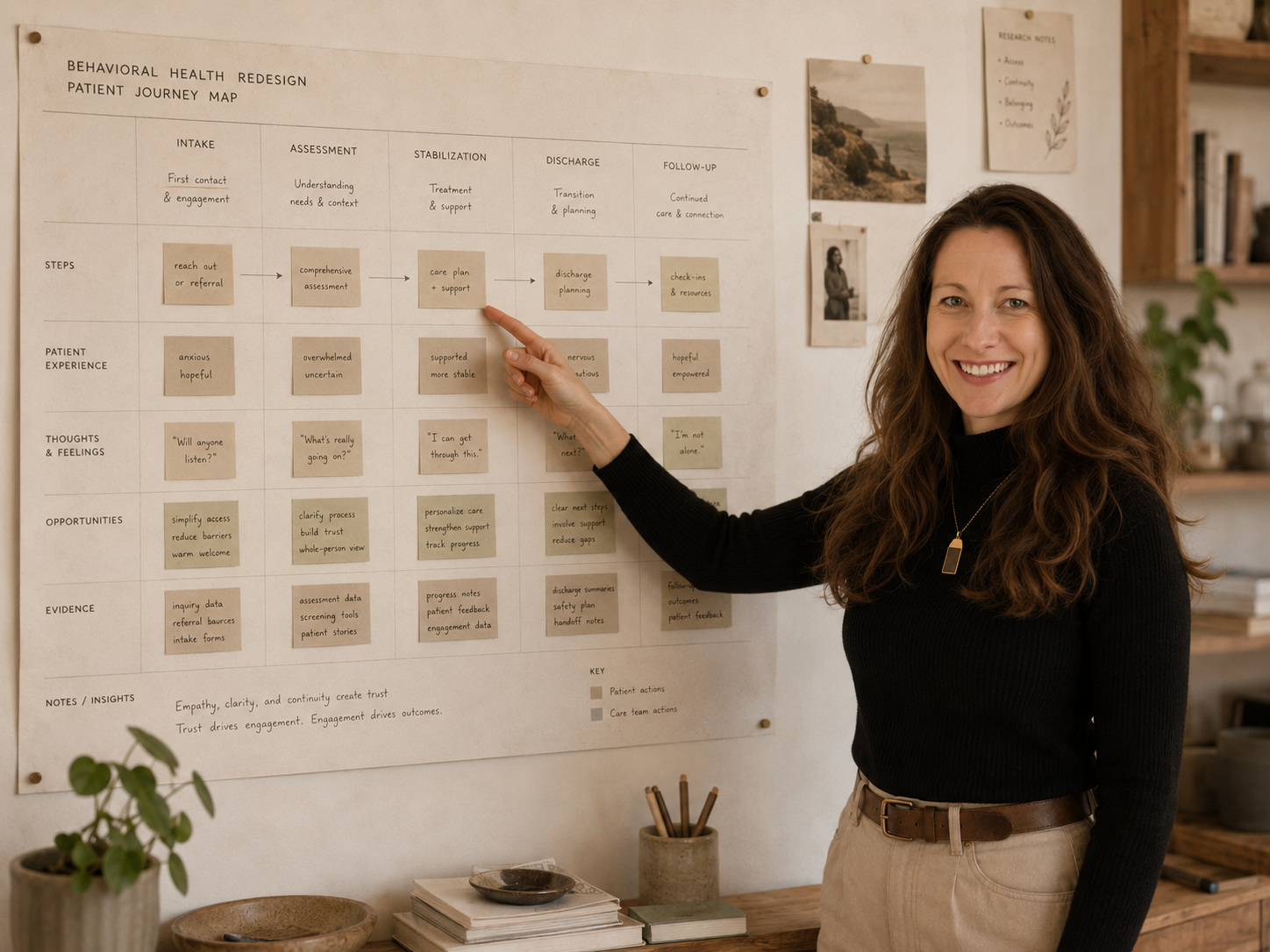
Mapped the full arc of behavioral health crisis care — from first contact through emergency department experience, discharge, referral, and follow-up.
The framework identified high-friction moments and translated them into practical intervention points.
- 02
Peer Recovery Coach Integration Model
Designed the role logic, workflow, and handoff model for integrating peer recovery coaches into emergency department contexts.
The peer role mattered because the cue was human. Someone who could say: I know this place. I know this feeling. You are not alone in it.
- 03
Multi-Site Co-Design
Facilitated co-design sessions across hospital sites and stakeholder groups.
The work created a shared language between teams that were often solving adjacent pieces of the same problem without seeing the whole system.
- 04
Grant Strategy + Narrative
Developed the funding strategy and grant narrative to support behavioral health recovery program expansion.
The work helped secure $180K in grant funding for peer recovery integration and program infrastructure.
Outcomes
What changed.
The work helped move rural behavioral health support from fragmented intent toward an implementable model.
- $180K
- Grant funding secured to support peer recovery integration and program infrastructure
- 3
- Rural hospitals included in the framework
- 350+
- Community members and stakeholders engaged through interviews, listening sessions, and co-design activities
- 1
- Shared patient experience framework across three communities
- Peer pathway
- Designed for emergency department integration and post-crisis transition
- Experience signals
- Early operational feedback suggested improved handoff quality, stronger staff support, and a clearer pathway for patients leaving crisis care
What Made the Work Hard
The problem was not one gap. It was a web of gaps.
- —Workforce.
- —Funding.
- —Stigma.
- —Workflow.
- —Follow-up.
- —Trust.
Solving one without the others would not hold.
That is why the framework mattered. It gave the system a way to see the whole pattern before choosing where to intervene.
What This Changed
The project sharpened my understanding of service design.
A service is not only a workflow.
It is a set of promises.
- Who will be there?
- What happens next?
- Will someone notice if the person does not return?
In rural behavioral health, those promises matter because the system is often thin. There are fewer fallback options. Fewer specialists. Fewer redundant pathways.
Design has to respect that. It has to work with the system that exists while making room for the system people deserve.
Reflection
The most important design decision was who was in the room.
Rural health design fails when it is done to communities instead of with them.
The peer recovery coaches changed the room because they carried lived experience the system could not simulate. They understood the fear, shame, exhaustion, and distrust that often sit underneath a crisis visit.
Their presence changed the signal. Not only for patients. For staff, too.
- —The framework mattered.
- —The grant mattered.
- —The workflow mattered.
But the deeper shift was ownership.
People who had been carrying different pieces of the same problem began to build from the same map. That is when a service starts to hold.
Collaborate
Service design for systems that cannot afford another brittle solution.
Open to strategy, service design, and advisory work at the intersection of rural health, behavioral health integration, care transitions, peer support, and participatory design.
← Previous case
Somatag — Adaptive Interface R&D
Next case →
CG Advocacy — AI for Civic Infrastructure