Case Study · Longitudinal HRV Research · Caregiving
The physiological cost of caregiving.
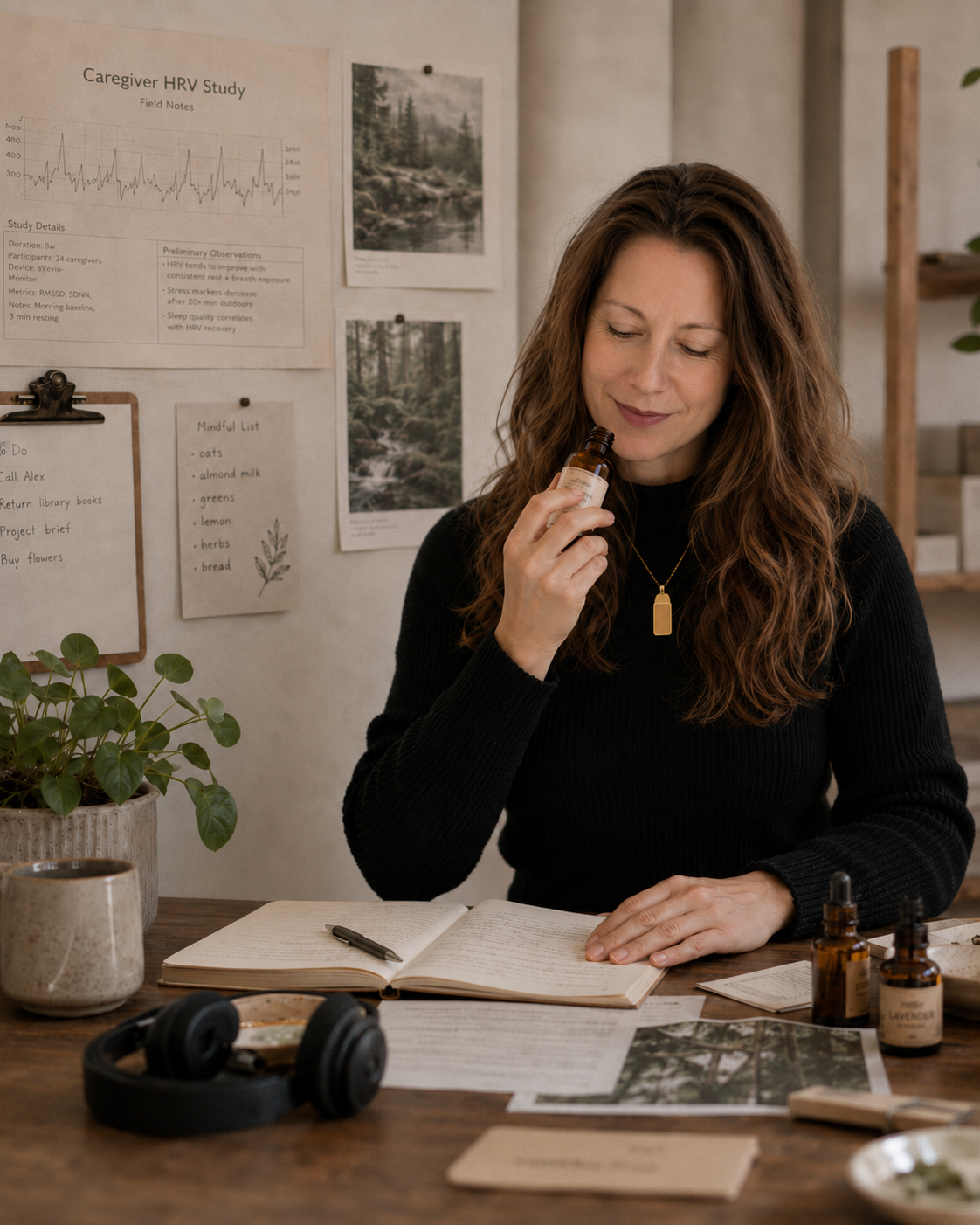
A 3.5-year IRB-approved longitudinal study exploring whether heart rate variability could reveal caregiver strain — and whether personalized sensory cues could support moments of autonomic return.
- Role
- Student Research Lead / Lead Researcher
- Institution
- Clemson Center for Success in Aging · Prisma Health
- Faculty Advisor
- Dr. Cheryl Dye
- Period
- 2011 — 2015
- Cohort
- 32 family caregivers of people living with Alzheimer's disease · 6 research assistants trained
- Research Focus
- Could physiological signals reveal caregiver strain earlier than self-report alone?
Origin
Heart rate variability became the signal.
They were not disappearing dramatically. They were disappearing quietly.
Each visit, the caregivers looked a little more tired. A little less present. They would smile and say they were fine — but their bodies often told a more complicated story.
HRV offered a way to study the autonomic nervous system — the part of the body involved in stress response, recovery, and regulation. When HRV shifts over time, it can suggest that the body is carrying strain before the person has words for it.
The question we began with was focused:
Could sensory interventions measurably shift HRV in a caregiving population?
The question I carried forward was larger:
If environment can influence physiology, why do so many care systems ignore it?
The Problem
Caregivers carry strain before systems can see it.
Family caregivers of people living with Alzheimer's disease often absorb the work of care without identifying as patients themselves. They manage medications, appointments, behavior changes, sleep disruption, household logistics, grief, vigilance, and uncertainty. Much of that labor is invisible.
By the time caregiver burnout becomes visible — through a health event, missed care, emotional collapse, or emergency escalation — the body may have been carrying strain for months.
Respite programs matter. Education matters. Community support matters. But many interventions depend on the caregiver noticing the need, asking for help, and having enough capacity left to act.
This study explored a different possibility: what if the body could become an earlier signal?
Method
A longitudinal study of rhythm, strain, and sensory return.
The protocol moved from physiological baseline to personalized intervention to community translation.
- 01
Baseline Mapping
Established individual HRV baselines for 32 caregivers using wearable biometric sensors.
The goal was not to compare each person to a generic norm.
The goal was to understand their own rhythm.
- 02
Emotional State Mapping
Paired physiological measurement with structured emotional-state mapping and qualitative observation.
Self-report mattered.
So did what the body showed.
- 03
Sensory Intervention Protocol
Tested personalized sensory interventions across three categories: music, nature imagery, and aromatherapy.
Each cue was selected with attention to preference, memory, context, and cultural meaning.
- 04
Longitudinal Observation
Studied HRV response patterns over 3.5 years.
The work was presented through Clemson's Focus on Creative Inquiry and Alzheimer's-related research forums.
- 05
Community Translation
The research informed a Dementia Caregiver Respite Program combining sensory intervention, caregiver support, and community-based implementation.
The goal was not only validity inside a university setting. The goal was a protocol that could be used beyond it.
Outcomes
What the study suggested.
The findings showed measurable autonomic response to personalized sensory cues — and helped translate research into a community-based caregiver support model.
- 21
- Family caregivers of people living with Alzheimer's / ADRD
- p = .05
- Statistically significant shift toward higher HRV coherence post-intervention
- 3
- Personalized sensory modalities tested — nature image, aroma, music
- 2.5 min
- Per-session reading protocol measured on the emWave2
- 3.5 yrs
- Longitudinal study duration
- 2
- Conference poster presentations
Findings
Three signals stayed with me.
- 01
Personalization mattered.
Generic sensory inputs produced inconsistent response.
Personally meaningful cues — a familiar song, a nature image connected to memory, a scent associated with safety or place — appeared to produce stronger autonomic shifts.
The cue had to belong to the person.
- 02
Environment could support return.
The study suggested that sensory environments can influence physiological state in measurable ways.
Not as a replacement for clinical care. As a low-burden layer of support that most care systems still underuse.
- 03
Translation had to be designed.
A research finding does not become useful because it is statistically interesting.
It becomes useful when the protocol can survive real rooms, real staff, real caregivers, and real constraints.
The community translation mattered because the work was designed for use — not only presentation.
Faculty Reflection
"Christine's contributions to our projects, particularly her leadership in Effects of Thoughts and Sensory Experiences on Heart Rate Variability of Older Adults, were nothing short of transformative."
What This Changed
This study became the first signal.
It shaped the through-line of my work: human capacity changes, and systems rarely notice early enough.
From there, the question kept evolving.
- —How might healthcare environments support regulation?
- —How might technology reduce burden instead of adding it?
- —How might care systems notice strain before crisis?
This research became the foundation for later work across behavioral health, healthcare innovation strategy, adaptive environments, and Somatag.
Lineage
- 2015 — 2019
Behavioral Health + Patient Experience
Carried the environment-as-intervention lens into behavioral health and patient experience work, especially where stress, stigma, and fragmented transitions shaped care.
- 2019 — 2021
CVS Health + Behavior Change
Applied behavioral insight and human-centered design to adherence, health literacy, and chronic-condition support within a national healthcare environment.
- 2023 — Present
Somatag + Adaptive Interface R&D
Returned to the original signal: physiological strain often appears before a person has capacity to ask for support. Somatag explores how screenless cues might support return for people carrying sustained cognitive, emotional, physiological, or caregiving load.
Reflection
What stayed with me was not only the numbers.
It was watching a body soften when the right song played.
That is what longitudinal research gives you. Not just a snapshot. Not just a moment of insight. The longer arc of a person under sustained pressure — and the small moments when something begins to shift.
The work taught me that care is not only delivered through services. It is also delivered through rhythm, environment, memory, and presence.
- A cue can matter.
- A signal can arrive early.
- A system can learn to respond with less force.
Collaborate
Research that left the university and kept working.
Open to research partnerships, health-system pilots, and academic collaboration where HRV, caregiver support, autonomic regulation, and real-world intervention design intersect.
Next case
CVS Health — Digital Health Behavior Change